Quickstart for EpiLearn
forecasting
For forecasting task, Epilearn initialzes a Forecast class with model prototyes and the dataset. Before building the task, a UniversalDataset is used to load the spatial&temporal data and transformations are defined and applied.
import torch
from epilearn.models.Temporal import DlinearModel
from epilearn.data import UniversalDataset
from epilearn.tasks.forecast import Forecast
from epilearn.utils import transforms


lookback = 16 # inputs size
horizon = 1 # predicts size

dataset = UniversalDataset(name='JHU_covid', root='./tmp/')
inputs = dataset.x[0,:].unsqueeze(1)

dataset = UniversalDataset(x=inputs, y=inputs)

transformation = transforms.Compose({
                "features": [transforms.normalize_feat()],
                "target": [transforms.normalize_feat()]
                })
dataset.transforms = transformation

task = Forecast(prototype=DlinearModel,
                    dataset=None,
                    lookback=lookback,
                    horizon=horizon,
                    device='cpu')

result = task.train_model(dataset=dataset,
                        loss='mse',
                        epochs=50,
                        batch_size=16,
                        train_rate=0.6,
                        val_rate=0.1,
                        permute_dataset=False,
                        )

eval_result = task.evaluate_model(model=task.model,
                                features=task.train_split['features'],
                                targets=task.train_split['targets'])

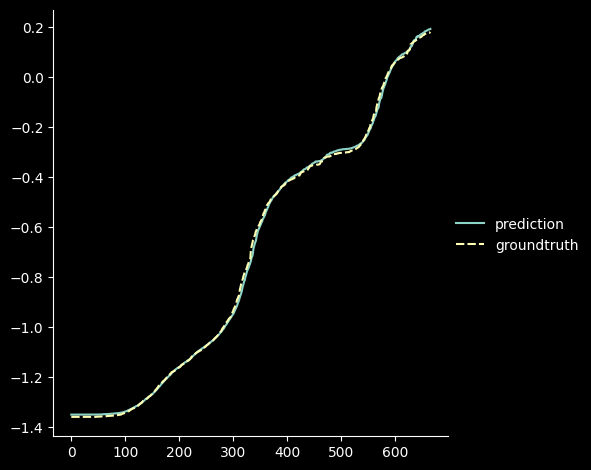
forecasts = task.plot_forecasts(task.train_dataset, index_range=[0, -1])
Detection
For detection task, the process is the same as the forecast task except that we initialze a Detection task.
import torch
from epilearn.tasks.detection import Detection
from epilearn.models.Spatial.GCN import GCN

graph = torch.round(torch.rand((47, 47))) # nodes, nodes
features = torch.round(torch.rand((10,47,1,4))) # batch, nodes, time steps=1, channels
node_target = torch.round(torch.rand((10,47))) # batch, nodes

dataset = UniversalDataset(x=features,y=node_target,graph=graph)

lookback = 1 # inputs size
horizon = 2 # predicts size; also seen as number of classes

dataset.transforms = None
task = Detection(prototype=GCN, dataset=dataset, lookback=lookback, horizon=horizon, device='cpu')

result = task.train_model(dataset=dataset,
                        loss='ce',
                        epochs=25,
                        train_rate=0.6,
                        val_rate=0.1,
                        permute_dataset=False,
                        #   model_args=model_args
                        )

train_evaluation = task.evaluate_model(model=task.model,
                                features=task.train_split['features'],
                                graph=task.adj,
                                dynamic_graph= task.train_split['dynamic_graph'],
                                states=task.train_split['states'],
                                targets=task.train_split['targets'])